

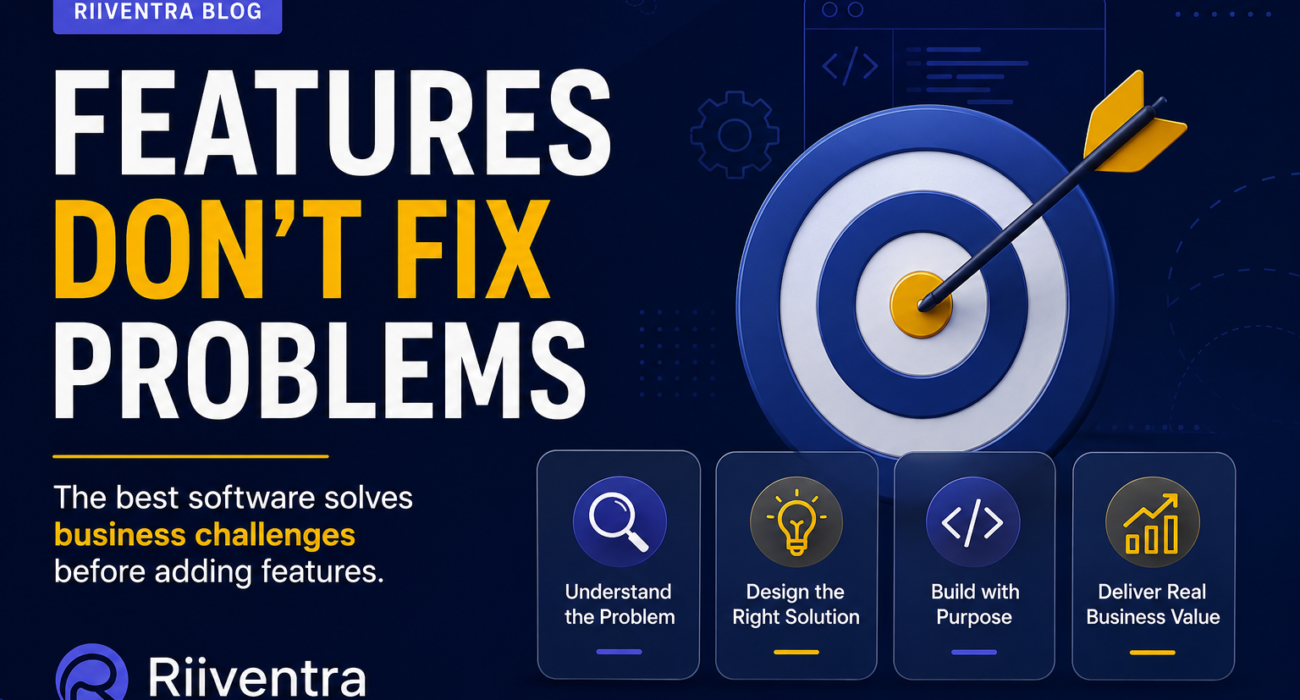
Why Features Don’t Fix Problems: A Better Approach to Software Development
Focus Keyword: Features Don’t Fix Problems
Introduction
When businesses decide to invest in software, the conversation often starts with features.
“We need a dashboard.”
“We need reporting.”
“We need automation.”
“We need a customer portal.”
While these requests may seem reasonable, they often lead companies down the wrong path. The most successful software projects don’t start with a feature list—they start with understanding the business problem.
At Riiventra, we’ve worked with organizations across different industries, and one lesson consistently stands out:
Features don’t fix problems. Solutions do.
The Common Mistake Businesses Make
Many business owners approach software development with a long list of desired features.
The assumption is simple: more features mean more value.
However, adding features without understanding the underlying business challenge often results in:
- Increased development costs
- Longer project timelines
- Low user adoption
- Unnecessary complexity
- Poor return on investment
Software should not be built around assumptions. It should be built around business outcomes.
A Real-World Scenario
Recently, a client approached us with a detailed list of software requirements.
Their requested platform included:
- Advanced reporting
- Multiple user roles
- Customer management tools
- Workflow automation
- Inventory tracking
At first glance, the requirements seemed comprehensive.
However, after analyzing their operations, we discovered that the real issues were much simpler:
1. Excessive Manual Work
Employees were spending hours performing repetitive tasks that could easily be automated.
2. Data Stored Across Multiple Systems
Critical information was scattered between spreadsheets, emails, and third-party applications.
3. Lack of Operational Visibility
Management had no real-time insight into business performance and daily activities.
The problem wasn’t a lack of features.
The problem was inefficiency.
Why Understanding the Problem Matters
Before writing a single line of code, businesses should ask:
What challenge are we trying to solve?
A clear understanding of the problem helps organizations:
- Prioritize the right functionality
- Reduce unnecessary development costs
- Improve software adoption
- Accelerate implementation
- Deliver measurable business value
Without this clarity, software becomes another expensive tool that employees struggle to use.
The Right Software Development Process
At Riiventra, we follow a problem-first approach.
Step 1: Understand the Business Process
We identify bottlenecks, inefficiencies, and operational challenges.
Step 2: Define Desired Outcomes
Instead of discussing features, we focus on business goals such as:
- Reducing manual work
- Improving customer experience
- Increasing operational efficiency
- Enhancing reporting and visibility
Step 3: Design the Right Solution
Only after understanding the problem do we recommend specific features and technologies.
Step 4: Build with Purpose
Every feature must directly support a business objective.
Step 5: Measure Results
Successful software should create measurable improvements in productivity, efficiency, and profitability.
Signs Your Business Needs a Custom Solution
You may need custom software if your team is experiencing:
- Too many spreadsheets
- Duplicate data entry
- Disconnected systems
- Manual reporting processes
- Workflow bottlenecks
- Limited visibility into operations
These challenges often indicate that your current tools are no longer aligned with how your business operates.
Focus on Outcomes, Not Features
The best software projects are not defined by how many features they include.
They are defined by the business problems they solve.
Before investing in your next software project, ask yourself:
“What business problem are we trying to eliminate?”
The answer to that question should guide every development decision that follows.
Because in the end, businesses don’t need more software.
They need software that works for them.
Conclusion
Technology should simplify operations, improve efficiency, and support growth.
When organizations focus on solving real business challenges instead of chasing features, they create software that delivers lasting value.
At Riiventra, we believe every successful software project starts with understanding the problem first and building the solution second.
Features don’t fix problems. Understanding the problem does.