

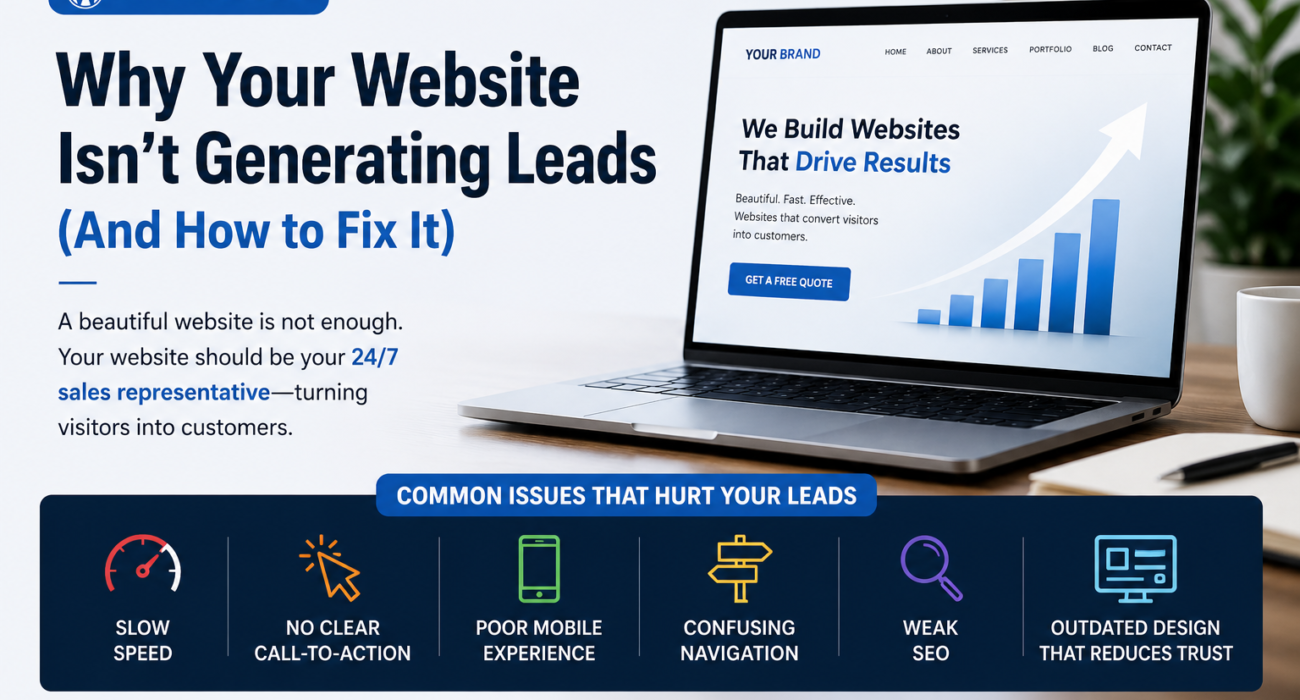
Is Your Website Working for Your Business?
Many business owners invest in a professional-looking website, expecting it to generate inquiries and sales automatically. Unfortunately, having a beautiful website doesn’t guarantee results.
If your website receives visitors but very few inquiries, the problem isn’t necessarily your marketing—it could be your website’s performance, usability, or user experience.
Let’s explore the most common reasons websites fail to generate leads and how you can fix them.
1. Slow Website Loading Speed
Today’s users expect websites to load within a few seconds. A slow website causes visitors to leave before they even see your services.
How to Fix It
- Compress and optimize images
- Enable browser caching
- Minify CSS and JavaScript
- Choose reliable web hosting
- Use a Content Delivery Network (CDN)
Result: Faster websites improve user experience, search engine rankings, and conversion rates.
2. No Clear Call-to-Action (CTA)
Visitors shouldn’t have to guess what to do next.
If your website lacks clear buttons like:
- Get a Free Quote
- Book a Consultation
- Contact Us
- Request a Demo
you may be losing valuable leads.
Best Practice
Place a CTA on every important page and make it visually prominent.
3. Poor Mobile Experience
More than half of all website traffic comes from mobile devices.
If users need to zoom in, struggle to navigate, or wait for pages to load, they’ll likely leave.
Improve Mobile Experience
- Use responsive layouts
- Make buttons easy to tap
- Optimize fonts and spacing
- Test your website on multiple devices
4. Confusing Navigation
Visitors should find what they need in seconds.
Complex menus and cluttered pages create frustration and increase bounce rates.
Keep Navigation Simple
Include only essential menu items such as:
- Home
- About
- Services
- Portfolio
- Blog
- Contact
The easier your website is to navigate, the more likely visitors are to stay.
5. Weak SEO Strategy
Even the best-designed website won’t generate leads if people can’t find it.
Search Engine Optimization (SEO) helps your business appear in search results when potential customers are looking for your services.
Improve Your SEO
- Research relevant keywords
- Optimize page titles and meta descriptions
- Publish valuable blog content regularly
- Improve internal linking
- Optimize images with descriptive alt text
SEO is a long-term investment that can deliver consistent, high-quality traffic.
6. Outdated Design Reduces Trust
Your website represents your business online.
An outdated design can make visitors question your credibility, even if your services are excellent.
Modern Websites Should Include
- Clean layouts
- Professional branding
- High-quality visuals
- Customer testimonials
- Fast performance
- Secure HTTPS connection
A modern website builds confidence and encourages visitors to take action.
Build Trust with Social Proof
People trust businesses that have proven results.
Add:
- Customer reviews
- Testimonials
- Case studies
- Client logos
- Project portfolios
These elements help reduce hesitation and improve conversions.
Track and Improve Performance
Your website should continue improving over time.
Use analytics tools to monitor:
- Visitor behavior
- Bounce rate
- Conversion rate
- Most visited pages
- Traffic sources
Small improvements based on real data often produce significant growth.
Final Thoughts
Your website should be more than an online brochure—it should be your most effective marketing and sales tool.
By improving speed, user experience, SEO, mobile responsiveness, navigation, and trust signals, you can turn more visitors into paying customers.
Remember, increasing leads doesn’t always require more advertising. Often, optimizing your existing website delivers the biggest return on investment.
Need Help Improving Your Website?
Whether you’re using WordPress, Laravel, or a custom-built platform, investing in website optimization can help your business attract more visitors, generate more inquiries, and grow with confidence.