

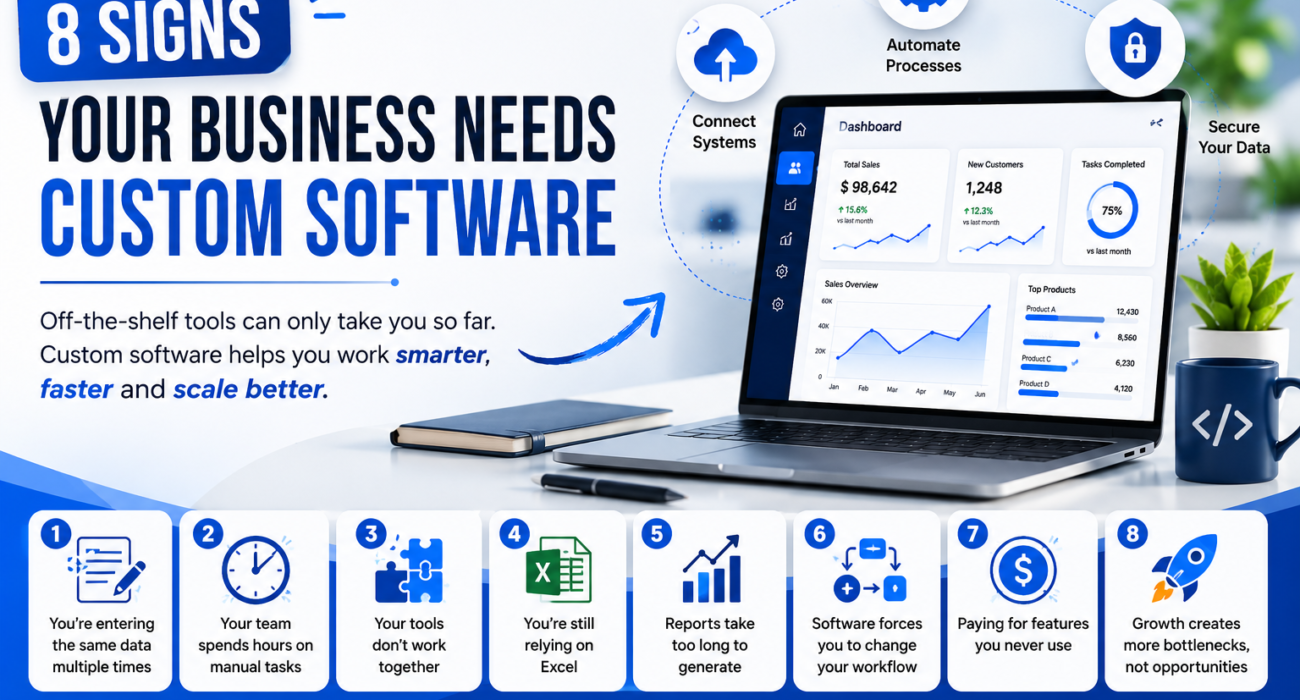
Businesses today rely on software for almost everything—from managing customers and inventory to handling finances and communication. When you’re just starting out, off-the-shelf software and spreadsheets often provide an affordable and convenient solution.
However, as your business grows, these generic tools can become obstacles rather than assets. If your team spends more time working around software limitations than actually getting work done, it may be time to consider a custom software solution.
In this article, we’ll explore eight clear signs that your business has outgrown standard software and explain how custom software can help you operate more efficiently, reduce costs, and prepare for future growth.
What Is Custom Software?
Custom software is designed specifically for your business processes and goals. Unlike ready-made applications that serve thousands of businesses with different needs, custom software is built around your workflows, allowing your team to work more efficiently without unnecessary features or limitations.
Whether it’s a customer portal, CRM, ERP system, inventory management platform, booking system, or internal dashboard, custom software adapts to your business—not the other way around.
1. You’re Entering the Same Data Multiple Times
One of the biggest productivity killers is duplicate data entry.
Imagine entering customer information into your CRM, accounting software, inventory system, and email platform separately. Besides wasting valuable time, this also increases the chance of human error.
Custom software can:
- Automatically synchronize information
- Eliminate duplicate entries
- Improve data accuracy
- Save countless hours every month
2. Your Team Spends Too Much Time on Manual Tasks
Are employees manually creating invoices, updating spreadsheets, generating reports, or sending repetitive emails?
These repetitive tasks reduce productivity and prevent your team from focusing on activities that actually grow your business.
Custom software can automate:
- Invoice generation
- Customer notifications
- Inventory updates
- Report creation
- Employee workflows
- Approval processes
Automation leads to fewer errors and faster operations.
3. Your Business Tools Don’t Work Together
Many businesses use several different platforms:
- CRM
- Accounting software
- Email marketing
- Inventory management
- Payment gateway
- ERP
- HR software
When these systems don’t communicate, employees constantly switch between applications and manually transfer information.
Custom software integrates all your tools into one connected ecosystem, improving workflow and eliminating unnecessary manual work.
4. You’re Still Managing Critical Operations in Excel
Excel is incredibly useful—but it isn’t designed to manage growing businesses.
If your company relies heavily on spreadsheets for:
- Inventory
- Customer records
- Sales tracking
- Employee management
- Reporting
it’s probably time for a more scalable solution.
As businesses grow, spreadsheets become difficult to manage, prone to errors, and challenging to share across teams.
5. Reports Take Too Long to Generate
Business decisions depend on accurate, real-time information.
If managers spend hours collecting data from multiple sources just to create weekly reports, valuable decision-making time is being lost.
Custom dashboards can provide:
- Real-time sales reports
- Financial summaries
- Customer analytics
- Inventory status
- Performance metrics
Everything becomes available with just a few clicks.
6. Your Software Forces You to Change Your Workflow
Many businesses modify their internal processes simply because their software doesn’t support the way they naturally operate.
This often leads to:
- Extra manual steps
- Employee frustration
- Reduced productivity
- Complicated workarounds
Custom software is built around your existing workflow, making it easier for employees to adapt and work efficiently.
7. You’re Paying for Features You Never Use
Subscription software often includes hundreds of features that many businesses never need.
Unfortunately, you’re still paying for them every month.
At the same time, the features you actually require may not even exist.
Custom software gives you:
- Only the features you need
- No unnecessary complexity
- Better performance
- Lower long-term operational costs
8. Business Growth Is Creating More Bottlenecks
Growth should make your business stronger—not more difficult to manage.
If adding more customers means:
- More paperwork
- More manual processes
- More employee stress
- More operational delays
your systems aren’t scaling with your business.
Custom software grows alongside your company, allowing you to handle more customers, employees, and operations without sacrificing efficiency.
Benefits of Custom Software
Investing in custom software offers long-term advantages that extend beyond automation.
Increased Productivity
Employees spend less time on repetitive tasks and more time delivering value.
Better Customer Experience
Faster service, quicker response times, and personalized experiences improve customer satisfaction.
Improved Data Security
Custom software can include security features tailored to your business, helping protect sensitive information.
Seamless Integration
Connect your CRM, accounting software, payment gateways, marketing tools, and internal systems into one unified platform.
Scalability
As your business grows, your software can grow with it—without requiring costly replacements.
Competitive Advantage
Unique software tailored to your business processes can help you operate more efficiently than competitors relying on generic solutions.
Is Custom Software Worth the Investment?
Many business owners assume custom software is only for large enterprises.
In reality, small and medium-sized businesses often see significant returns because automation reduces labor costs, minimizes errors, and improves efficiency.
When implemented correctly, custom software becomes an investment that saves both time and money over the long term.
Final Thoughts
Every business reaches a point where spreadsheets and off-the-shelf software can no longer keep up with growth.
If you recognize several of the signs discussed above, it may be time to consider a solution built specifically for your business.
Custom software isn’t about replacing every tool overnight—it’s about creating systems that simplify operations, improve productivity, and support future growth.
The right solution can help your team work smarter, make better decisions, and deliver exceptional experiences for your customers.
Ready to streamline your business operations? Investing in custom software today can help build a more efficient, scalable, and future-ready business tomorrow.