

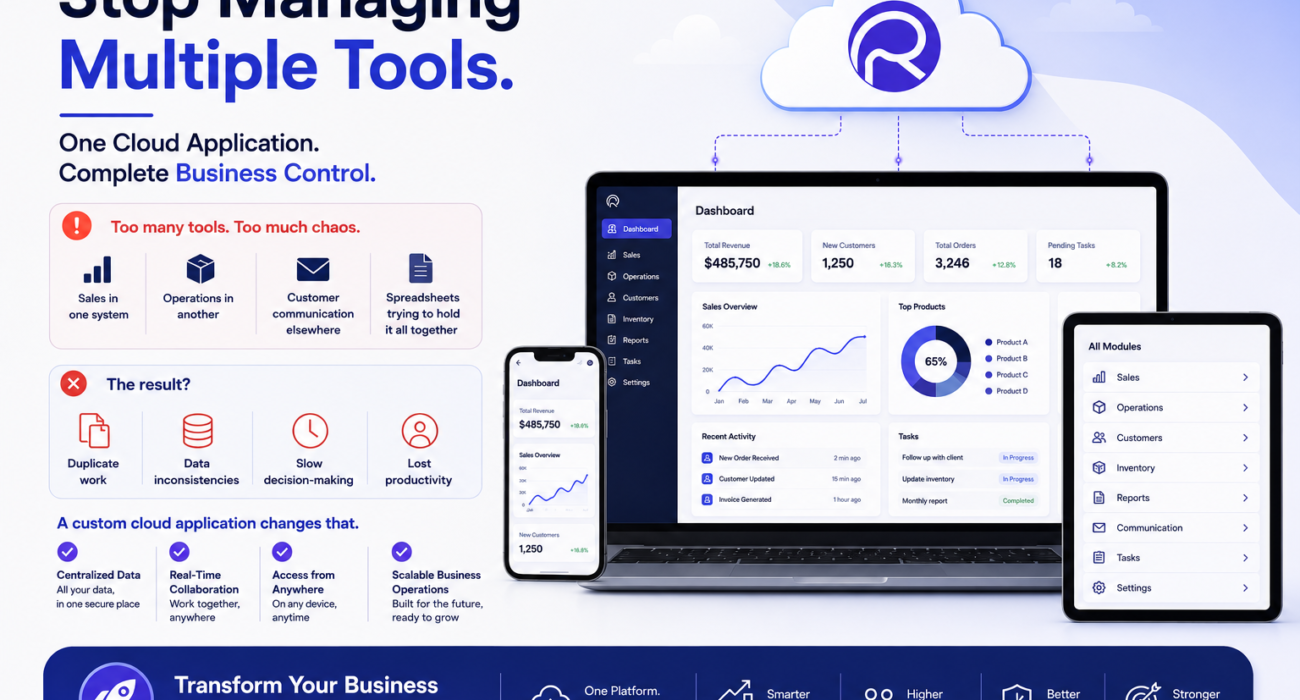
Stop Managing Multiple Tools: Why Businesses Need a Unified Cloud Application
Modern businesses rely on software more than ever before. Yet many organizations face a common challenge: too many disconnected tools.
Sales teams use one platform. Operations rely on another. Customer communication happens somewhere else. Important reports are stored in spreadsheets. As the business grows, so does the complexity.
Instead of improving efficiency, these disconnected systems often create confusion, duplicate work, and operational bottlenecks.
The solution isn’t adding another tool.
The solution is building a unified cloud application that brings everything together.
The Problem with Multiple Business Tools
Many companies start by adopting software to solve individual problems.
Over time, they accumulate a collection of platforms for:
- Sales Management
- Customer Support
- Inventory Management
- Operations
- Accounting
- Reporting
- Team Collaboration
While each tool serves a purpose, the lack of integration creates significant challenges.
Common Problems Businesses Face
Duplicate Work
Employees often enter the same information into multiple systems. This wastes valuable time and increases the likelihood of errors.
Data Inconsistencies
When information is spread across different platforms, teams may work with outdated or conflicting data.
This can lead to poor decisions and customer service issues.
Slow Decision-Making
Business leaders need accurate, real-time information.
When data exists in multiple systems, generating reports becomes time-consuming and often unreliable.
Reduced Productivity
Employees spend more time switching between applications than focusing on meaningful work.
The result is lower efficiency and increased frustration.
What Is a Custom Cloud Application?
A custom cloud application is a centralized software solution designed specifically around your business processes.
Instead of adapting your workflow to fit multiple third-party tools, the software is built to match how your business operates.
Accessible through the internet, cloud applications provide secure, real-time access from any location and device.
Benefits of a Unified Cloud Application
1. Centralized Data Management
A cloud application stores all critical business information in one place.
This means:
- One source of truth
- Improved data accuracy
- Better visibility across departments
- Easier reporting and analytics
When everyone works from the same data, teams become more aligned and productive.
2. Real-Time Collaboration
Modern businesses need teams that can collaborate effectively regardless of location.
Cloud applications allow employees to:
- Share information instantly
- Track updates in real time
- Improve communication
- Reduce delays in decision-making
Whether your team works remotely, in-office, or across multiple locations, everyone stays connected.
3. Access From Anywhere
Business doesn’t stop when employees leave the office.
Cloud applications provide secure access from:
- Desktop computers
- Laptops
- Tablets
- Mobile devices
This flexibility empowers teams to stay productive wherever they are.
4. Scalability for Future Growth
As your company grows, your software should grow with it.
A custom cloud solution allows businesses to:
- Add new users easily
- Expand features when needed
- Integrate with external platforms
- Support increasing workloads
You avoid the limitations often associated with off-the-shelf software.
5. Enhanced Security
Security is one of the biggest concerns for modern organizations.
Custom cloud applications can include:
- Role-based access controls
- Data encryption
- Automated backups
- Activity tracking
- Multi-factor authentication
This helps protect sensitive business information while ensuring compliance and reliability.
6. Better Business Visibility
When all business operations are connected through a single platform, leadership gains valuable insights.
Real-time dashboards and reports help organizations:
- Monitor performance
- Identify bottlenecks
- Track key metrics
- Make data-driven decisions
The result is greater control over business operations.
When Should You Consider a Custom Cloud Application?
A custom cloud solution may be the right choice if:
- Your team uses multiple disconnected systems
- Data is frequently duplicated
- Reporting takes too much time
- Employees struggle with inefficient workflows
- Existing software no longer meets your needs
- You are planning to scale your business
Why Custom Software Often Delivers Better ROI
While off-the-shelf software can solve short-term problems, businesses often outgrow generic solutions.
Custom cloud applications eliminate unnecessary features, reduce software subscriptions, and streamline operations.
By focusing on your unique processes, a custom solution often delivers stronger long-term value and operational efficiency.
Final Thoughts
Technology should simplify business operations, not complicate them.
If your organization is struggling with disconnected tools, duplicated work, and inefficient workflows, a custom cloud application can transform how your business operates.
By centralizing data, improving collaboration, enhancing security, and supporting future growth, cloud applications help businesses become more efficient, productive, and competitive.
The future belongs to businesses that operate through connected systems rather than disconnected tools.
Investing in a unified cloud application today can create the foundation for sustainable growth tomorrow.